Perimenopause Workout Plan: 4 Weeks of Strength Training at Home
A simple, equipment-light 4-week strength plan for women in perimenopause. Three sessions a week, a few foundational movement patterns, and gentle progressive overload you can do at home.

Published October 13, 2026 · 5 min read · 11 sources
You’ve decided to start lifting. Now you just need to know what to do.
This simple plan gives you three short strength sessions per week, using foundational movements and small, steady progressions. No random workouts. No guesswork.
For best recovery, do the sessions on non-consecutive days, such as Monday, Wednesday, and Friday.
The Foundation
Each workout is full-body and includes five basic movement patterns:
- Squat: bodyweight squat or goblet squat
- Hinge: hip hinge or Romanian deadlift
- Push: wall push-up, incline push-up, or floor press
- Pull: resistance band row or dumbbell row
- Core stability: dead bug, bird dog, or plank
These movements train several muscles at once and carry over well to daily life. For each exercise, start with 2–3 sets and focus on controlled form.
As you lift, try to exhale during the hardest part of the movement instead of holding your breath.
Weeks 1–4
Week 1: Learn the Movements
Do 2 sets of 8–10 reps for each exercise.
Choose a weight or variation that feels challenging but manageable. You should finish each set feeling like you could still do a few more reps with good form.
Week 2: Add Reps
Keep the same exercises and resistance, but increase to 10–12 reps per set.
The goal is to build confidence and consistency before making things harder.
Week 3: Add a Little Challenge
Choose one small progression:
- Add a third set
- Use a slightly heavier weight
- Try a slightly harder variation
- Increase your range of motion
Progressive overload simply means gradually increasing the challenge over time. It should feel steady, not rushed.
Week 4: Hold Steady
Repeat Week 3 and focus on smooth, controlled movement.
If you feel tired, sore, or under-recovered, make this a lighter week. Reducing volume or intensity when needed can help you stay consistent long term.
Adjust Based on How You Feel
Perimenopause can bring changes in sleep, energy, joint comfort, and recovery. Your plan should be flexible.
On rough-sleep days, lower the weight or do fewer sets instead of forcing a hard workout. If you feel strong and well-rested, stick with the plan and progress gradually.
If hot flashes are an issue, train in a cooler space, wear breathable clothing, keep water nearby, and pace yourself.
What to Expect
In the first few weeks, progress may feel subtle. You may notice better coordination, more control, and more confidence before you see visible changes.
That is normal. Strength is built through repeated practice, recovery, and gradual progression.
The Bottom Line
A beginner strength plan does not need to be complicated. Start with full-body workouts, train 2–3 times per week, focus on good form, and increase the challenge slowly.
Small steps, repeated consistently, are what build lasting strength.
If you’d like this plan tailored to your body, schedule, equipment, and goals, that’s exactly what coaching with Gabby is for.
This article is for educational purposes only and does not replace medical advice. Talk with your physician about any health concerns, pain, pelvic floor symptoms, or bone-health diagnosis before starting a new exercise program.
Your next step
Training built for your body, this season of it
A personalized program from a coach who understands perimenopause and menopause. Tell us about you and we'll take it from there.
Frequently asked questions
Do I need equipment for this perimenopause workout plan at home?
Not much. Bodyweight, a pair of dumbbells or a backpack, and a resistance band cover every movement. Because the plan is built around movement patterns, you can swap in whatever you have, then progress by adding reps, sets, or a slightly harder variation.
Will strength training make me bulky?
No. Standard strength training builds strength and metabolic health, but muscle gain is gradual and shaped by genetics, nutrition, hormones, and training volume. Women don't automatically get bulky from lifting.
What if I'm too tired or sleeping badly on a training day?
Scale it down instead of skipping. Do fewer sets, use a lighter load, or keep to the easier movements. Training should be adjusted during poor-sleep periods, especially for heavy or high-intensity work, and showing up in a smaller way still builds the habit.
References
Every claim above traces to a reviewed source in Gabby's research library.
- For most people, training major muscle groups 2–3 times per week can be an effective way to distribute weekly training volume, support recovery, and promote strength and muscle adaptation — ACSM Position Stand: Progression Models in Resistance Training
- Compound movements like squats, deadlift variations, and rows can provide strong functional benefits for women over 35 because they build strength across multiple joints and muscle groups used in everyday movement. — NASM WFS Chapter: Integrated Program Design
- Anti-rotation and anti-extension core exercises train the trunk to resist unwanted movement and support spinal stability during loaded tasks. Crunches may train trunk flexion, but crunches alone do not fully address the core’s stabilizing role in lifting, carrying, and daily movement. — McGill SM, Ultimate Back Fitness and Performance (5e)
- Exhaling during the hardest part of a lift can help clients avoid breath-holding and better manage pressure through the core and pelvic floor. — NASM WFS — Core, Balance, Plyometric & SAQ
- Progressive overload — gradually increasing resistance, repetitions, volume, or exercise difficulty over time — is a fundamental principle for building strength across adulthood. It should be applied gradually and adjusted to the individual’s age, experience, recovery, and health status. — NASM WFS Chapter: Resistance Training for Women
- Planned deload weeks — periods of reduced training volume and/or intensity — can help manage accumulated fatigue and support long-term training consistency. They may be scheduled periodically or used when signs of fatigue, soreness, poor sleep, or stalled performance appear. — NASM Essentials of Personal Fitness Training
- For heavy strength training, resting long enough between sets helps maintain performance. Research comparing 3-minute and 1-minute rests found greater strength gains with the longer rest period. — Schoenfeld BJ, J Strength Cond Res, 2016
- Because sleep disruption is common during perimenopause, training should be adjusted during poor-sleep periods, especially for heavy, high-volume, or high-intensity sessions. — Baker FC et al., Sleep Med Clin, 2018
- For clients prone to hot flashes, exercise can still be beneficial, but session comfort may improve with cooler environments, breathable clothing, hydration, and gradual pacing. — NASM WFS — Menopause Considerations
- In the early weeks of a new strength program, many strength gains come from neural adaptations — improved coordination, motor control, and muscle recruitment. Visible muscle changes usually take longer and become more noticeable with consistent training, adequate nutrition, and progressive overload. — NASM Essentials of Personal Fitness Training
- Strength training helps women build strength, muscle, and metabolic health. Because muscle gain is gradual and influenced by genetics, nutrition, hormones, and training volume, standard strength training does not automatically make women “bulky.” — NASM Women's Fitness Specialization curriculum
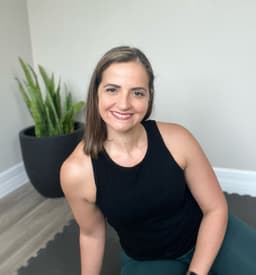
Written & reviewed by
Gabby
NASM-Certified Personal Trainer with 15+ years of experience, currently completing the advanced NASM Women's Fitness Specialization. Every article here is grounded in her coaching experience and traceable, sourced research — never generic advice.
About Gabby